joining with us

Search This Website

Showing posts with label HISTORY. Show all posts

Friday, December 18, 2020

History of Paghdi

History of Paghdi


Interesting History of Turban (Turban History): At one time turban was used for icard work, find interesting history of 370 types of turbans, latest news, job updates, technical tips and general information updates, please stay with us. Share this post with your friends.

Why forget the turban that identifies people and sect without Aadhaar card or document. Why is that culture.


Paghdi no Rasprad itihas (History of Paghdi)
Wednesday, December 16, 2020 


Paghdi no Rasprad itihas (History of Paghdi): Once upon a time, turbans were used for icard work, find out the interesting history of 370 types of turbans,Latest News, jobs Updates, Technology Tips and General Information Updates, remain with us avakarnews Please share with your companions this Post.
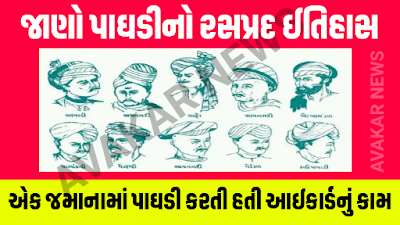


PAGHDI ITIHAS


Why has turban heritage been limited to hobbies since time immemorial?


Naresh Dharani, Ahmedabad: When there were no passport size photos, there was no Aadhaar card, there was no election and there was no ration card. At that time, turbans were the identity of the people and the community. But now the same turban has become a hobby or a museum. People are happy to see this traditional culture in the museum and the traditional turban has taken the form of a helmet today. There are different types of helmets on people's heads today. But there was a time when different types of turbans appeared on people's heads. Not only that but Prime Minister Narendra Modi also never forgets to wear the traditional turban wherever he goes.


There is a saying ‘don’t wear a closed turban’. But in reality one must sit close and wear a turban. If you wear a loose green turban you will be the center of laughter among the people. Because ‘Long cloak, mustache curly, night of turban’ is the identity of the last Gujaratis. There is also a tradition of wearing a turban. What turban and how to wear is just as important. Why is it also said that if the turban of ego falls from our head, all the problems of our life will disappear in a matter of hours!

370 types of turbans in India: It is said that turbans were worn by men. The region and the man were identified only by his turban. A total of 370 types of turbans are found in India. There are more than 50 turbans which were considered the pride of Saurashtra. If we look at the names of such different turbans. Vinjan's turban, Okha's turban, Babini's turban, Sorathi's turban, Vadwani's turban, Kathi's turban, Khuman's turban, Babrani's turban, Jaisalmer, Mewad, Ahmedabadi turban, Gaikwadi turban, Bhogpadi Black turban, Mughalshahi turban, Vhora turban, Sonasali turban, Marathi Chogdar Safo.

The turban was used to identify the area: in earlier times people did not have to ask where you came from. Because the turban worn on the man's head said everything. There were more than 20 different types of turbans including Kathiawadi Halai, Kutchi, Laria of seven different colors, Rajasthani, Jalawadi, Gohilwad, Sorathi. In which red turbans and white turbans were worn on mourning occasions.

Prime Minister Modi wears the traditional turban of the region wherever he goes


Whether it is a politician, a leader, an actor, meetings or films, the importance of turban has been shown everywhere. That is why even our Prime Minister does not forget to wear a turban wherever he goes. The Prime Minister's tour from Jamnagar to every region of Jammu and Kashmir has seen him in a traditional turban. Let's first talk about Jammu and Kashmir where Prime Minister Lal Soni was seen in a border turban. So in Arunachal Pradesh, the Prime Minister was seen in a different light in a traditional turban. Similarly, the Prime Minister has been seen in traditional turbans including Marathi, Jamnagar's traditional red turban, Rajasthani. Not only that but in regions like Purnanchal, Tripura the Prime Minister has been seen in different estimates in hats and caps.

READ HERE HIATORY OF PAGHDI IN GUJARATI

As the region changes, so does the turban: Morbi's fence, Gondal's beak, Jamnagar's ical bhi poles, Bardi's patliyali, Barde's khumpawali, Jhalawar's siege, Ghin's serious eye lying ears, Sorath's straight girlo. Left or right side of the same knot, Kathiawadi turban full of art, Shir Palanti, Bharwad's Bhojparu, Rabari at night, clean the sepoys, green cloth to the fakirs, forgive the munjavars

How many types of turbans are found in Gujarat ?: Different traditional hairs are found in different regions of Gujarat. , Abdaso, Modaso, Kanthi and Prantadhi turbans are found. Chorad, Jatwado, Nahar, Viyar, Dhandhar, Chappan, Patanwado and Dandavavya types of turbans are found in North Gujarat. Ahmedabad has Bhal, Kaner and Nalkanth turbans. Regional turbans are found among people of different castes living in Khambhatbaru, Wankal, Sankheda, Mahuvan, Kanthal, Nimad, Khandesh, Mewar, Raj, Mathor, Dang and Baglan sects in South Gujarat.

Thanks for visiting this amazing post, stay tuned with us for more posts.

To Get Fast Updates Download our Apps:Android||Telegram

Stay connected with us for latest updates

Important: Please always Check and Confirm the above details with the official website and Advertisement / Notification.

Thursday, November 26, 2020

RANI KI VAV AMAZING VIDEO AND INFORMATION

 RANI KI VAV AMAZING VIDEO AND INFORMATION


Rani ki Vav is a famous stepwell (stepwell) located in Patan in the Indian state of Gujarat. The image has been painted on a ₹ 100 note by the RBI (Reserve Bank of India) in July 2018 and was included in the UNESCO World Heritage Site on 22 June 2014. [1]


Patan was earlier known as 'Anhilpur', the former capital of Gujarat. It is said that Rani ki Vav (Bawdi) was built in the year 1063 by his wife Rani Udayamati in memory of King Bhimdev I of Solanki rule. Rani Udayamati was the daughter of Ra 'Khengar, the Chudasama ruler of Junagadh. The founder of the Solanki dynasty was Mulraj. The stairwell containing the ladder was once filled with silt due to the waters of the Saraswati river. This wav is 64 meters long, 20 meters wide and 27 meters deep. It is one of its kind in India.


The pillars of the Vav lead back to the times of the Solanki dynasty and their architectural marvels. Most of the carvings on the walls and pillars of the Vava are dedicated to Lord Vishnu in various forms of incarnations like Rama, Vamana, Mahishasuramardini, Kalki, etc. 


A formal announcement has been made to include 'Rani Ki Vav' in the new list of World Heritage. This Vava, built in the 11th century, has also been given the title of Queen of all Bawdi or Vav (Stepwell) located in India by the World Heritage Committee of UNESCO. It is considered an excellent example of the technique of using ground water resources in water management systems. This is the most developed and comprehensive example of the unique type of 11th century Indian underground architectural structure, which shows the saga of the development of Vav construction in India. This seven-story Vava is evidence of the Maru-Gurjar style. It was buried in Gad after the disappearance of the Saraswati river for nearly seven centuries. It was traced back to the Archaeological Survey of India. The Archaeological Survey of India (ASI) has also digitized the documents of Vav in collaboration with Sayark and Scottis Ten.


The 11th century Rani ki Vav (stepwell) in Gujarat has been approved by UNESCO as a World Heritage Site. UNESCO considers this to be a typical example of technology development in utilizing ground water resources. The Ministry of Culture said on Sunday that Rani's Vav has been approved to be included in the World Heritage List. This recognition was given by UNESCO during the recent World Heritage Committee session in Doha, Qatar's capital.


Rani ki Vav is a unique example of Indian underground architecture. At the same time, Prime Minister Narendra Modi praised UNESCO's decision to place Rani's Vav in the World Heritage List.


Wrote it as a matter of pride. In a tweet, Modi said, Rani ki Vav in Patan, Gujarat has been included in the UNESCO heritage list. Next time you go to Gujarat then definitely go to Rani ki Vav.


Apart from this, UNESCO has also included the ancient silk route (Silk Route) and Great Canal, the world's most artificial waterway in Beijing, China. The Silk Road has been a path of trade and cultural exchange between Asia and Europe two thousand years ago.


A ladder well, Rani ki Vav was built in 1063 by Queen Udayamati in loving memory of her husband King Bhimdev. King Bhimdev was the founder of the Solanki dynasty. More wells containing stairwells have filled the sludge due to the water of river Saraswati.


This stepwell built below the ground is about 64 meters long, 20 meters wide and 27 meters deep. Originally it was a seven-storey building, but now only five of its floors have been preserved. Due to the floods caused by geological changes and the lost Saraswati river, this valuable heritage was buried under layers of silt for almost 700 years. According to a geologist, it is a beautiful example of the highest growth of Bavalis in India. It is a large and intricately structured stepwell, this step holds its special place in the category of stepwell wells in India. UNESCO has considered this stepwell as a unique example of the technical and water management system of using groundwater resources in a single structure. It is the most developed and comprehensive example of a unique type of 11th century Indian underground architectural structure, which is the water harvesting in India. The development saga. Our forefathers used to use groundwater with the distinction that with the system it reflected a beauty. There is no response to 'Rani ki Vav' as a source of groundwater use and water management system. In the 38th meeting of the UNESCO World Heritage Committee held in Doha, Qatar, Vav was given the prestigious recognition of 'World Heritage'. 


WATCH THE AMAZING VIDEO OF RANI KI VAV


UNESCO considers it to be an excellent example of technological development in which better water management and groundwater has been used with the distinction that the system has an aesthetic beauty to it. In February 2013, the Department of Archaeological Survey of India called it Was nominated for the World Heritage List. The local people of Patan have also contributed significantly in getting this precious heritage of India included in the World Heritage List. So far 31 sites in India have been included in the World Heritage List, including Rani's Wav. These include 24 cultural sites.


Turning the layers of history, it is known that Patan was the capital of Gujarat under Raja Jai ​​Singh. Then its name was Anhilpur. It was discovered by Vanraj Fourteenth. Rani Udayamati was built in 1063 in memory of her husband and King Bhimdev I of Patan. Bhimdev was the founder of the Solanki dynasty of Patan.


To Get Fast Updates Download our Apps:Android||Telegram

Stay connected with us for latest updates

Important: Please always Check and Confirm the above details with the official website and Advertisement / Notification.

Categories

Our Followers

Popular Posts

Any Problem Or Suggestion Please Submit Here

Name

Email *

Message *